Riemannian Geometry
This page provides the minimal vocabulary necessary to follow the rest of the documentation and use geodex effectively. It is not an exhaustive introduction to differential geometry. For a rigorous treatment of Riemannian geometry, see [Lee, 2018]. For readers interested in the computational aspects relevant to this library, see [Boumal, 2023] and [Absil et al., 2008].
A smooth manifold \(\mathcal{M}\) is a topological space that locally looks like a familiar Euclidean space \(\mathbb{R}^n\). Each point \(p \in \mathcal{M}\) has an associated tangent space \(\mathcal{T}_p\mathcal{M}\), the vector space of all instantaneous velocities passing through \(p\). Tangent vectors \(v \in \mathcal{T}_p\mathcal{M}\) are the directions in which you can move on the manifold.
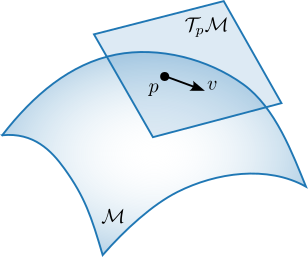
A Riemannian metric \(g\) equips every tangent space with a smoothly varying inner product:
This inner product allows us to define lengths and angles on the manifold. The norm of a tangent vector \(v \in \mathcal{T}_p\mathcal{M}\) is defined as:
Geodesics \(\gamma\) are the generalization of straight lines in flat spaces to manifolds. They are locally length-minimizing curves with zero acceleration.
The exponential map \(\exp_p : \mathcal{T}_p\mathcal{M} \to \mathcal{M}\) follows the geodesic starting at \(p\) with initial velocity \(v\):
The logarithmic map \(\log_p : \mathcal{M} \to \mathcal{T}_p\mathcal{M}\) is the local inverse of the exponential map: it returns the tangent vector at \(p\) pointing toward \(q\):
The geodesic distance between two points is the length of the shortest connecting geodesic:
This formula requires exact exp/log. When only approximations are available, geodex falls back to the midpoint approximation, which is covered alongside the discrete interpolation algorithm in Discrete Geodesic Interpolation.
Retractions are first- or second-order approximations to the exponential map. They are cheaper to evaluate and preserve the manifold topology, but unlike the true exponential they are not isometries. geodex separates retractions from metrics as independent policy types, as discussed in Concept Hierarchy and Architecture.
References
P.-A. Absil, Robert Mahony, and Rodolphe Sepulchre. Optimization Algorithms on Matrix Manifolds. Princeton University Press, 2008.
Nicolas Boumal. An Introduction to Optimization on Smooth Manifolds. Cambridge University Press, 2023.
John M. Lee. Introduction to Riemannian Manifolds. Springer, 2nd edition, 2018.