Minimum-Energy Planning on Configuration Manifolds
This tutorial shows how we can use geodex to find minimum-energy motions for robot configuration spaces modeled as Riemannian manifolds. To keep things simple, we will only work in two dimensions, using a two-link planar manipulator as the running example. We will make use of two Riemannian metrics widely used in the literature for energy-aware planning for articulated systems: the Kinetic Energy metric and the Jacobi metric (see [Kyaw and Kelly, 2026, Jaquier and Asfour, 2022, Li et al., 2024]).
Setting up Our Planar Manipulator
To begin, we will model the standard two-link planar arm with the following parameters:
Symbol |
Default |
Description |
|---|---|---|
\(l_1, l_2\) |
1.0 m |
Link lengths |
\(m_1, m_2\) |
1.0 kg |
Link masses |
\(l_{c1}, l_{c2}\) |
0.5 m |
CoM distances from joint (\(l/2\) for uniform rods) |
\(I_1, I_2\) |
1/12 kg·m² |
Moments of inertia (\(m l^2 / 12\)) |
\(g\) |
9.81 m/s² |
Gravitational acceleration |
Kinetic Energy Metric
The kinetic energy metric at configuration \(q\) is defined by the manipulator’s mass matrix \(M(q)\):
A path \(\gamma\) in configuration space has Riemannian arc-length
which is precisely the “kinematic effort” or the energy required to execute \(\gamma\) at unit speed. Geodesics of this metric are straight lines in the inertia-weighted sense: they minimize the total effort while respecting the arm’s inertial structure [Bullo and Lewis, 2004]. Because \(M(q)\) depends on each configuration, the metric is anisotropic and varies across the manifold.
Defining the Mass Matrix
To compute the kinetic energy of the manipulator, we need its mass matrix \(M(q)\). For a standard two-link planar arm, the mass matrix can be derived from the Euler-Lagrange equations. The components of this \(2 \times 2\) symmetric matrix are defined as:
Most configuration-space metrics in geodex accept callable objects as constructor arguments. We can implement this mass matrix elegantly as a functor:
struct PlanarArmMassMatrix {
   double l1=1.0, l2=1.0, m1=1.0, m2=1.0;  // link lengths (m) and masses (kg)
   double lc1=0.5, lc2=0.5;                // CoM distances from joint (m)
   double I1=1.0/12.0, I2=1.0/12.0;        // moments of inertia (kg·m²)

   Eigen::Matrix2d operator()(const Eigen::Vector2d& q) const {
      double c2 = std::cos(q[1]);       // cos(q2): elbow coupling term
      double h  = l1 * lc2 * c2;       // inertial coupling coefficient
      Eigen::Matrix2d M;
      M(0,0) = I1 + I2 + m1*lc1*lc1 + m2*(l1*l1 + lc2*lc2 + 2.0*h);
      M(0,1) = I2 + m2*(lc2*lc2 + h);
      M(1,0) = M(0,1);
      M(1,1) = I2 + m2*lc2*lc2;
      return M;
   }
};
import numpy as np

class PlanarArmMassMatrix:
    def __init__(self, l1=1.0, l2=1.0, m1=1.0, m2=1.0,
                 lc1=0.5, lc2=0.5, I1=1/12, I2=1/12):
        self.l1, self.m1, self.lc1, self.I1 = l1, m1, lc1, I1
        self.l2, self.m2, self.lc2, self.I2 = l2, m2, lc2, I2

    def __call__(self, q):
        c2 = np.cos(q[1])              # cos(q2): elbow coupling term
        h  = self.l1 * self.lc2 * c2  # inertial coupling coefficient
        m00 = (self.I1 + self.I2 + self.m1*self.lc1**2
               + self.m2*(self.l1**2 + self.lc2**2 + 2*h))
        m01 = self.I2 + self.m2*(self.lc2**2 + h)
        return np.array([[m00, m01], [m01, self.I2 + self.m2*self.lc2**2]])
Using the mass matrix above, we can build the configuration space on \(\mathbb{R}^2\) (with bounds \([-\pi, \pi]^2\)) and define Riemannian metrics using geodex:
#include <geodex/geodex.hpp>

// instantiate the mass matrix functor as above
PlanarArmMassMatrix mass_fn;

// construct the Kinetic Energy Riemannian metric
geodex::KineticEnergyMetric ke_metric{mass_fn};

// create the configuration space: Euclidean base manifold + kinetic energy metric
geodex::ConfigurationSpace cspace_ke{geodex::Euclidean<2>{}, ke_metric};
import geodex

# instantiate the mass matrix functor as above
mass_fn = PlanarArmMassMatrix()

# construct the Kinetic Energy Riemannian metric
ke_metric = geodex.KineticEnergyMetric(mass_fn)

# create the configuration space: Euclidean base manifold + kinetic energy metric
cspace_ke = geodex.ConfigurationSpace(geodex.Euclidean(2), ke_metric)
Jacobi Metric
Maupertuis’ variational principle [Arnold, 1989] states that the natural trajectories of a conservative mechanical system (solutions of Newton’s equations at fixed total energy \(H\)) are exactly the geodesics of the Jacobi metric:
where \(P(q)\) is the potential energy and \(H > P(q)\) everywhere on the path (the arm must have enough energy to reach every configuration).
We can interpret this physically: where kinetic energy is large (i.e., \(P(q) \ll H\)), the arm moves quickly, and the conformal factor \(2(H - P(q))\) scales the metric up. This makes these regions appear geometrically larger and therefore incentivising paths that pass through them. Conversely, near regions where \(P(q) \approx H\), the metric shrinks to zero and paths are forced away.
Formulating Gravity Potential
To use this, we need to account for the potential energy \(P(q)\) acting on the arm due to gravity. This is the sum of the potential energies of the two links, calculated from the heights of their respective centers of mass:
// gravitational potential: sum of CoM heights weighted by mass and gravity
auto potential = [](const Eigen::Vector2d& q) {
   constexpr double g = 9.81, m1 = 1.0, m2 = 1.0, l1 = 1.0, lc1 = 0.5, lc2 = 0.5;
   return m1 * g * lc1 * std::sin(q[0])
         + m2 * g * (l1 * std::sin(q[0]) + lc2 * std::sin(q[0] + q[1]));
};
import numpy as np

# gravitational potential: sum of CoM heights weighted by mass and gravity
def potential(q, g=9.81, m1=1.0, m2=1.0, l1=1.0, lc1=0.5, lc2=0.5):
    return (m1 * g * lc1 * np.sin(q[0])
            + m2 * g * (l1 * np.sin(q[0]) + lc2 * np.sin(q[0] + q[1])))
Setting the Maximum Potential Bound
Working with the Jacobi metric requires us to define a total energy level \(H\) that strictly bounds the potential energy. This ensures that the kinetic energy remains positive (\(H > P(q)\) for all \(q\)).
For our two-link planar arm, we can analytically compute the upper bound of the potential energy, \(P_{\max}\), which occurs when the arm is fully extended directly upwards.
Using our default parameters, this yields approximately 19.62 J. We can define this as a constant:
constexpr double pmax = 9.81 * (1.0*0.5 + 1.0*(1.0 + 0.5)); // ~19.62 J
pmax = 9.81 * (1.0*0.5 + 1.0*(1.0 + 0.5)) # ~19.62 J
Similar to kinetic energy metric, we can construct a Jacobi metric. Here, we set \(H = 1.2\,P_{\max}\) (a 20% margin above the maximum potential energy) to ensure the metric is valid and well-conditioned everywhere in the configuration space:
constexpr double H = 1.2 * pmax;  // total energy: 20% above maximum potential
geodex::JacobiMetric jacobi_metric{mass_fn, potential, H};
geodex::ConfigurationSpace cspace_j{geodex::Euclidean<2>{}, jacobi_metric};
H = 1.2 * pmax  # total energy: 20% above maximum potential
jacobi_metric = geodex.JacobiMetric(mass_fn, potential, H)
cspace_j = geodex.ConfigurationSpace(geodex.Euclidean(2), jacobi_metric)
Visualizing the Configuration Space
To understand how these metrics behave across the manifold, we visualize their metric ellipses. A metric ellipse at configuration \(q\) is the unit ball of the inner product:
Equivalently, it is the eigenellipse of the inverse metric tensor \(G^{-1}(q)\). A physically larger ellipse indicates the metric is “looser” in that region, meaning less energy is required per unit of configuration displacement.
In both figures below, the background color maps the determinant of the metric tensor.
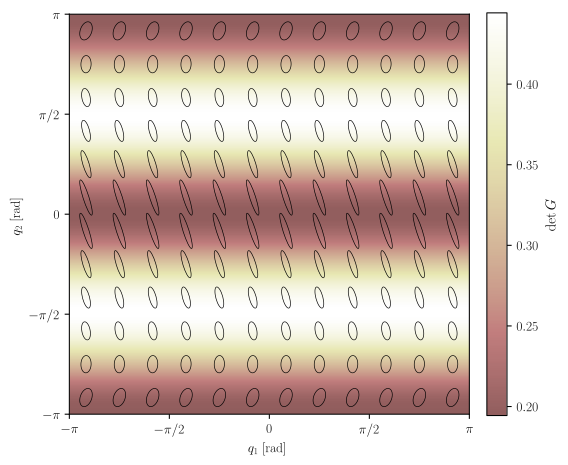
Figure: Kinetic energy metric ellipses over \([-\pi, \pi]^2\)
The kinetic energy metric ellipses, representing the unit balls of \(M(q)^{-1}\), change shape based purely on the elbow angle \(q_2\). Near \(q_2 = 0\) (arm extended), the coupling between shoulder and elbow is strongest and the ellipses are elongated along \(q_1\), reflecting the shoulder’s higher effective inertia. Near \(q_2 = \pm\pi\) (arm folded back), the links decouple and both joints share a similar effective inertia, resulting in nearly circular ellipses.
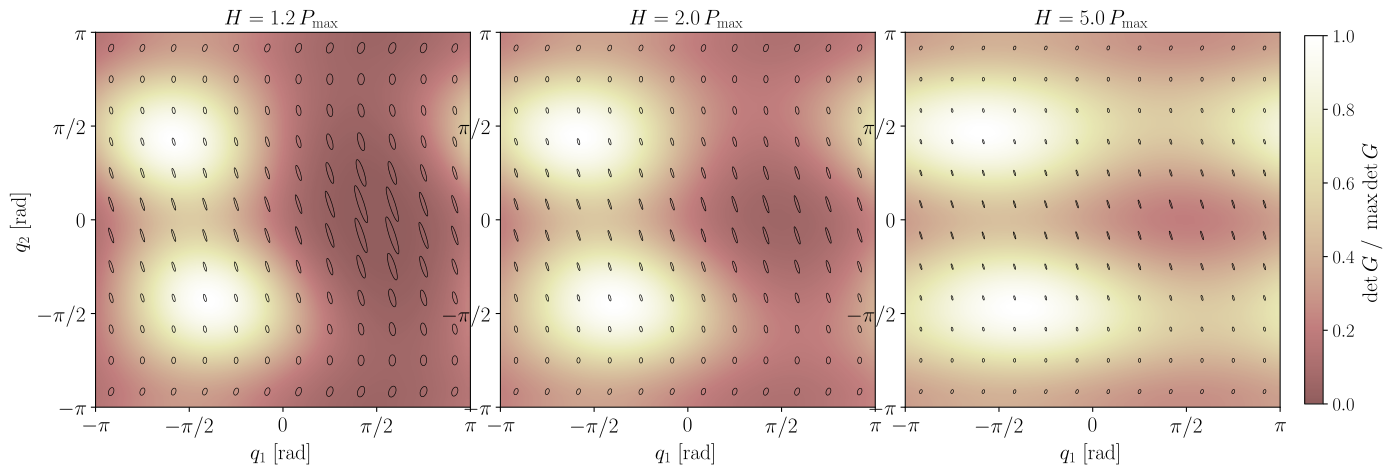
Figure: Jacobi metric ellipses at three energy levels
The Jacobi metric introduces a conformal scaling factor, \(2(H - P(q))\), driven by the total energy \(H\). The figure shows \(H\) at \(H = 1.2\,P_{\max}\) (left), \(H = 2.0\,P_{\max}\) (centre), and \(H = 5.0\,P_{\max}\) (right). At low energy (left), the conformal factor varies drastically. In high-potential regions where \(P(q) \approx H\), the ellipses shrink to near-zero, heavily penalizing paths through these configurations. As \(H\) increases (centre, right), the conformal factor becomes uniform, and the Jacobi ellipses scale globally and increasingly resemble the kinetic energy metric from the figure above.
Reproducing the figures:
# Requires matplotlib and LaTeX
pip install matplotlib
sudo apt update && sudo apt install -y texlive-latex-extra dvipng cm-super

# Configure and build
cmake -B build -DBUILD_EXAMPLES=ON
cmake --build build --target minimum_energy_grid

# Generate JSON data
./build/minimum_energy_grid minimum_energy_grid.json

# Render SVG figures
python scripts/visualize_metric_grid.py minimum_energy_grid.json \
    --output-dir docs/tutorials/figs/minimum-energy-planning
Planning with Asymptotically Optimal Planners
Note
This example requires OMPL, which must be built from source with modern CMake targets. See the OMPL installation guide for details.
With a clear picture of how these metrics reshape the geometry, we can now plan actual motions on it. We will run the motion planner three times on the same start and goal pairs, once with the Euclidean metric, once with the kinetic energy metric, and once with the Jacobi metric, and compare the resulting paths.
geodex provides an OMPL integration layer that wraps any RiemannianManifold as an ompl::base::StateSpace.
The two key classes are GeodexStateSpace (which delegates distance() and interpolate() to the manifold) and GeodexOptimizationObjective (which uses geodesic distance as the path cost).
Together, these allow you to plug any Riemannian metric into OMPL’s asymptotically optimal planners without needing to modify the underlying planner itself.
The following snippet shows how to set up and solve using RRT* algorithm with each of the three metrics (see the full example for details):
#include <geodex/geodex.hpp>
#include <geodex/integration/ompl/geodex_state_space.hpp>
#include <geodex/integration/ompl/geodex_optimization_objective.hpp>
#include <ompl/geometric/SimpleSetup.h>
#include <ompl/geometric/planners/rrt/RRTstar.h>

namespace ob = ompl::base;
namespace og = ompl::geometric;
using geodex::integration::ompl::GeodexStateSpace;
using geodex::integration::ompl::GeodexOptimizationObjective;

// -- Flat metric (identity on R^2) --
geodex::Euclidean<2> flat_euclidean;

// -- Kinetic energy metric --
PlanarArmMassMatrix mass_fn;                          // functor from above
geodex::KineticEnergyMetric ke_metric{mass_fn};
geodex::ConfigurationSpace cspace_ke{geodex::Euclidean<2>{}, ke_metric};

// -- Jacobi metric --
constexpr double H = 1.2 * pmax;
geodex::JacobiMetric jacobi_metric{mass_fn, potential, H};
geodex::ConfigurationSpace cspace_j{geodex::Euclidean<2>{}, jacobi_metric};

// Wrap any of the above as an OMPL state space (example: Jacobi)
ob::RealVectorBounds bounds(2);
bounds.setLow(-M_PI);
bounds.setHigh(M_PI);
auto space = std::make_shared<GeodexStateSpace<decltype(cspace_j)>>(cspace_j, bounds);

og::SimpleSetup ss(space);
// ... set start, goal, planner ...
auto objective = std::make_shared<
    GeodexOptimizationObjective<decltype(cspace_j)>>(
    ss.getSpaceInformation(), goal_coords);
ss.setOptimizationObjective(objective);
ss.setPlanner(std::make_shared<og::RRTstar>(ss.getSpaceInformation()));
ss.solve(5.0);
# Python bindings do not support OMPL integration.
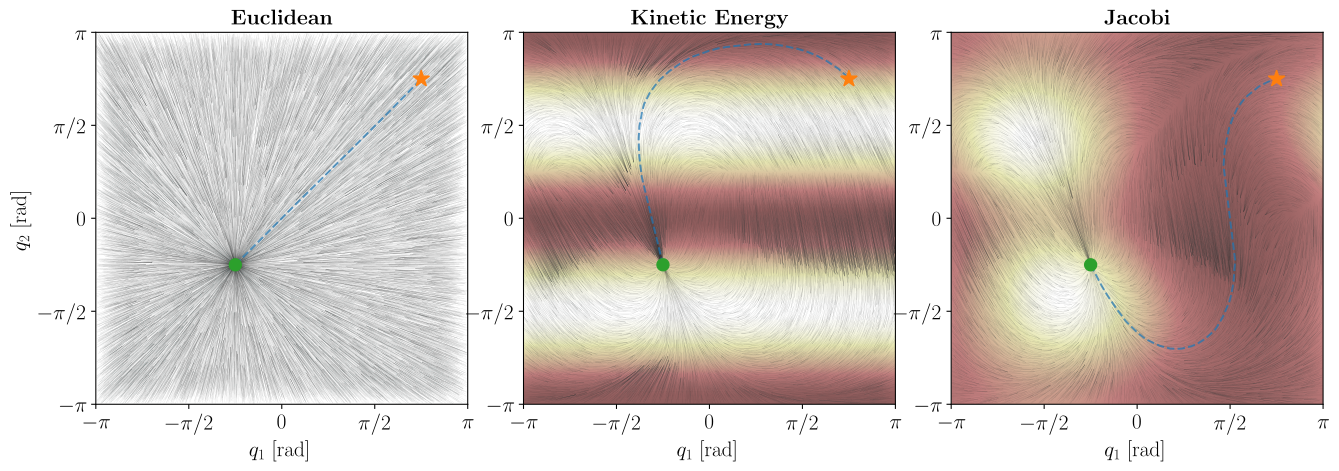
Figure: RRT* trees and solution paths under Euclidean (left), kinetic energy (centre), and Jacobi (right) metrics. Background colour maps the determinant of the respective metric tensor.
Under the Euclidean metric, the planner treats all joint displacements equally. The background is uniform (\(\det(I) = 1\) everywhere) and the solution path is just a straight line in joint space.
The kinetic energy metric biases the planner toward configurations where the effective inertia is lower. The background shows \(\det(M(q))\), which varies with the elbow angle. The path naturally curves toward folded-arm configurations (\(q_2\) near \(\pm\pi\)) to minimize kinematic effort.
The Jacobi metric explicitly penalises high-potential regions through its conformal factor \(2(H - P(q))\). The background shows \(\det(J(q))\), which shrinks toward zero near the potential ridge. Because distances grow to infinity as \(P(q)\) approaches \(H\), the planner is forced to route around the ridge. The resulting path safely avoids configurations where the arm would fight gravity, even if it requires a longer coordinate-space detour.
This tutorial demonstrates how the choice of Riemannian metric elegantly encodes physics directly into the planning objective. The Euclidean metric ignores physics, the kinetic energy metric respects inertial coupling, and the Jacobi metric accounts for both inertia and gravitational potential simultaneously.
Seeing the Arm in Motion
The animation below traces the two-link arm along all three solutions side by side.
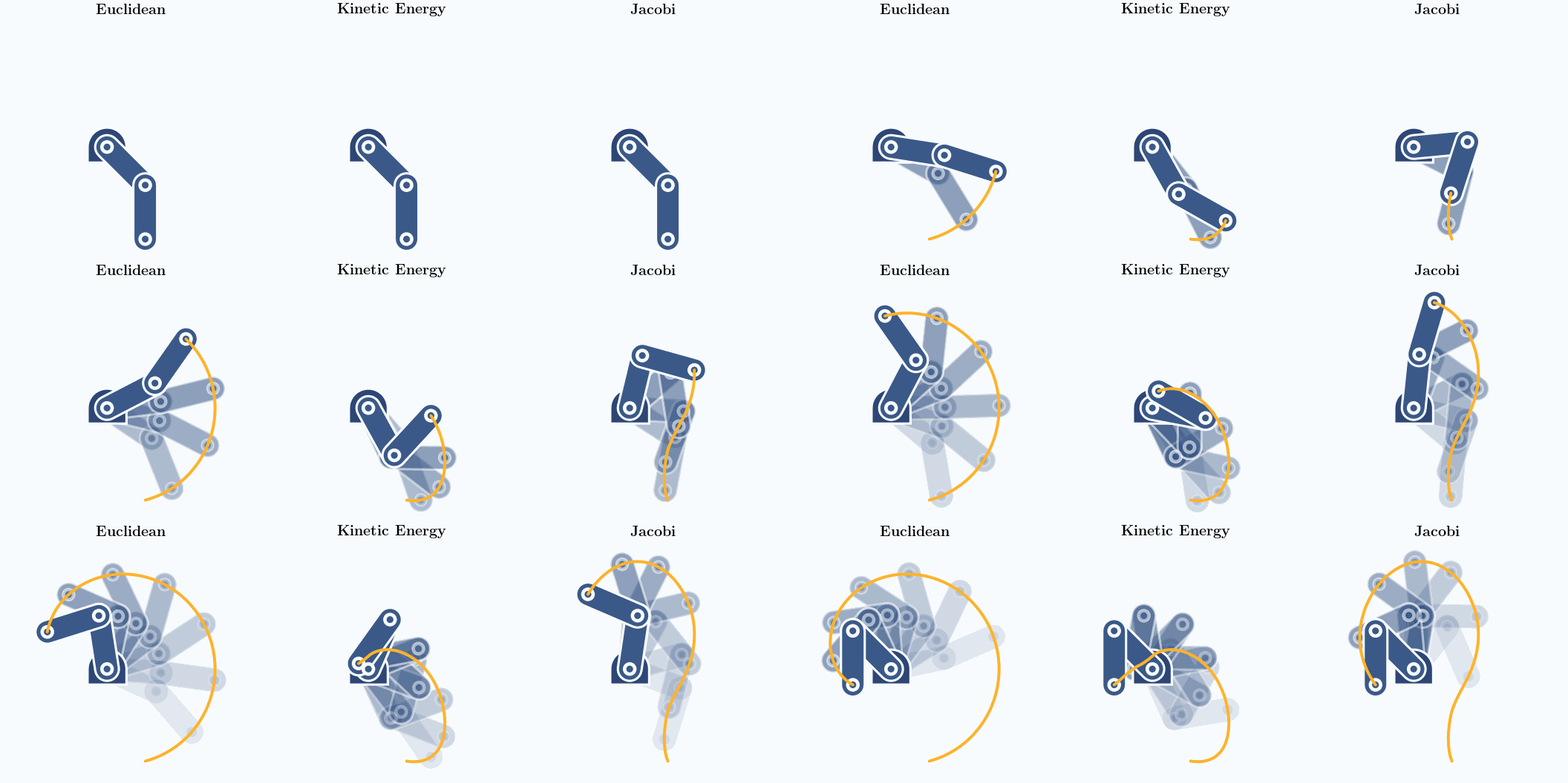
Figure: Planar arm sweeping along the Euclidean, kinetic-energy, and Jacobi minimum-energy paths.
Reproducing the figures:
# Requires matplotlib and LaTeX
pip install matplotlib
sudo apt update && sudo apt install -y texlive-latex-extra dvipng cm-super

# Configure and build (requires OMPL)
cmake -B build -DBUILD_OMPL_EXAMPLES=ON -Dompl_DIR=/path/to/ompl/install/share/ompl/cmake
cmake --build build --target minimum_energy_planning

# Run the planning example
./build/examples/ompl/minimum_energy_planning minimum_energy_planning.json

# Render SVG figure and animation
python scripts/visualize_minimum_energy_planning.py minimum_energy_planning.json \
    --output-dir docs/tutorials/figs/minimum-energy-planning
References
Vladimir I. Arnold. Mathematical Methods of Classical Mechanics. Springer, 2nd edition, 1989.
Francesco Bullo and Andrew D. Lewis. Geometric Control of Mechanical Systems. Volume 49. Springer, 2004.
Noémie Jaquier and Tamim Asfour. Riemannian geometry as a unifying theory for robot motion learning and control. In The International Symposium of Robotics Research, 395–403. Springer, 2022.
Phone Thiha Kyaw and Jonathan Kelly. Geometry-aware sampling-based motion planning on Riemannian manifolds. In Proceedings of the 17th World Symposium on the Algorithmic Foundations of Robotics (WAFR). Oulu, Finland, Jun. 15–17 2026. To Appear. URL: https://arxiv.org/abs/2602.00992.
Yiming Li, Jiacheng Qiu, and Sylvain Calinon. A riemannian take on distance fields and geodesic flows in robotics. arXiv preprint arXiv:2412.05197, 2024.